Executing Quick Find from Console Application : Redux
If you have been following my blog, you might remember this (https://dreamingincrm.com/2014/05/07/executing-quickfind-using-crm-sdk/) post about executing a quick find query from the console. It was using an undocumented message, and hence it is unsupported.
I had a crack at this problem one more time, this time using Actions.In order to return the quick find results, the custom action need to have a EntityCollection output parameter. I posted this (https://community.dynamics.com/crm/f/117/t/128534.aspx) question in CRM forums sometime back and didn’t get any response.
This is not production ready code and just demonstrates how this can be done. If you would rather read the code, instead of this post please find the download link in the very bottom.
Requirements:
For the search – should be able to specify:
1.) Entity name
2.) Search term
3.) Page number
4.) Number of records to be returned
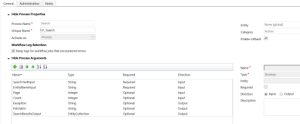
Step 1: Create a custom action
The body of the action is empty and doesn’t contain any logic. The actual quickfind will be performed by a plugin registered post-operation of this action.
Step 2: Create the plugin
using Microsoft.Xrm.Sdk;
using Microsoft.Xrm.Sdk.Query;
using System;
using System.Linq;
using System.Xml.Linq;
using Contract = System.Diagnostics.Contracts.Contract;

namespace QuickFindAction.Plugins
{
    public class QuickFindPlugin : IPlugin
    {
        internal IOrganizationService OrganizationService
        {
            get;

            private set;
        }

        internal IPluginExecutionContext PluginExecutionContext
        {
            get;

            private set;
        }

        internal ITracingService TracingService
        {
            get;

            private set;
        }

        public void Execute(IServiceProvider serviceProvider)
        {
            Contract.Assert(serviceProvider != null, "serviceProvider is null");
            PluginExecutionContext =
                (IPluginExecutionContext)serviceProvider.GetService(typeof(IPluginExecutionContext));
            TracingService = (ITracingService)serviceProvider.GetService(typeof(ITracingService));
            Contract.Assert(TracingService != null, "TracingService is null");

            try
            {
                var factory =
                    (IOrganizationServiceFactory) serviceProvider.GetService(typeof (IOrganizationServiceFactory));

                OrganizationService = factory.CreateOrganizationService(this.PluginExecutionContext.UserId);

                Contract.Assert(PluginExecutionContext.InputParameters.Contains("SearchTextInput"), "No SearchTextInput property");
                Contract.Assert(
                    !string.IsNullOrEmpty(PluginExecutionContext.InputParameters["SearchTextInput"].ToString()), "SearchTextInput is null or empty");
                Contract.Assert(PluginExecutionContext.InputParameters.Contains("EntityNameInput"), "No EntityNameInput property");

                string searchText = PluginExecutionContext.InputParameters["SearchTextInput"].ToString(),
                       searchEntity = PluginExecutionContext.InputParameters["EntityNameInput"].ToString();

                var savedViewQuery = string.Format(
                    @"<fetch version=""1.0"" output-format=""xml-platform"" mapping=""logical"" distinct=""false"">
                      <entity name=""savedquery"">
                        <attribute name=""fetchxml"" />
                        <filter type=""and"">
                          <condition attribute=""statecode"" operator=""eq"" value=""0"" />
                          <condition attribute=""isquickfindquery"" operator=""eq"" value=""1"" />
                          <condition attribute=""isdefault"" operator=""eq"" value=""1"" />
                          <condition attribute=""name"" operator=""like"" value=""%{0}%"" />
                        </filter>
                      </entity>
                    </fetch>", searchEntity);

                var quickFindFetchXml =
                    OrganizationService.RetrieveMultiple(new FetchExpression(savedViewQuery)).Entities[0].GetAttributeValue<string>("fetchxml");
                    TracingService.Trace("FetchXml read from SavedView");
                    var entityFetchXml = XElement.Parse(string.Format(quickFindFetchXml, string.Format("%{0}%", searchText)));

                if (PluginExecutionContext.InputParameters["Page"] != null)
                {
                    entityFetchXml.SetAttributeValue("page", PluginExecutionContext.InputParameters["Page"]);
                }
                if (PluginExecutionContext.InputParameters["Count"] != null)
                {
                    entityFetchXml.SetAttributeValue("count", PluginExecutionContext.InputParameters["Count"]);
                }

                entityFetchXml.Elements().Elements("filter").Elements().ToList().ForEach(x => {
                                                                                                  if (
                                                                                                      x.Attribute(
                                                                                                          "attribute")
                                                                                                          .Value
                                                                                                          .EndsWith("id"))
                                                                                                  {
                                                                                                      x.SetAttributeValue("attribute",x.Attribute("attribute").Value+"name");
                                                                                                  } });
                PluginExecutionContext.OutputParameters["FetchXml"] = entityFetchXml.ToString();

                var results = OrganizationService.RetrieveMultiple(new FetchExpression(entityFetchXml.ToString()));
                PluginExecutionContext.OutputParameters["SearchResultsOutput"] = new EntityCollection(results.Entities.ToList());
            }
            catch (Exception e)
            {
                TracingService.Trace(e.StackTrace);
                PluginExecutionContext.OutputParameters["Exception"] = e.StackTrace;
                throw;
            }
        }
    }
}
Step 3: Register the plugin
Step 4: Create the Console Application
using System;
using System.Collections.Generic;
using System.Linq;
using System.Net;
using System.Text;
using System.Threading.Tasks;
using Microsoft.Crm.Sdk.Messages;
using Microsoft.Xrm.Sdk;
using Microsoft.Xrm.Tooling.Connector;

namespace ActionsTester
{
    class Program
    {
        static void Main(string[] args)
        {
            try
            {
                var executeQuickFindRequest = new OrganizationRequest("ryr_Search");
                executeQuickFindRequest["SearchTextInput"] = "sus";
                executeQuickFindRequest["EntityNameInput"] = "contact";
                executeQuickFindRequest["Page"] = 1;
                //executeQuickFindRequest["Count"] = 1;

                var crmSvc =
                    new CrmServiceClient(new NetworkCredential("administrator", "p@ssw0rd1", "CRM"),
                                         AuthenticationType.AD, "crm1", "80", "Contoso");
                if (crmSvc.IsReady)
                {
                    crmSvc.OrganizationServiceProxy.Execute(executeQuickFindRequest);
                    OrganizationResponse response = crmSvc.OrganizationServiceProxy.Execute(executeQuickFindRequest);
                    if (response.Results.Contains("Exception") && response.Results["Exception"] != null)
                    {
                        Console.WriteLine(response.Results["Exception"]);
                        Console.WriteLine(response.Results["FetchXml"]);
                        return;
                    }
                    if (response.Results["SearchResultsOutput"] != null)
                    {
                        Console.WriteLine(response.Results["FetchXml"]);
                        var results = (EntityCollection) response.Results["SearchResultsOutput"];
                        foreach (var record in results.Entities)
                        {
                            record.Attributes.ToList().ForEach(x=> Console.WriteLine("{0}={1}",x.Key,Unwrap(x.Value)));
                            Console.WriteLine();
                        }
                    }
                }
            }
            catch (Exception e)
            {
                Console.WriteLine(e.StackTrace);
            }
        }

        private static object Unwrap(object attributeValue)
        {
            var unwrappedValue = attributeValue;
            if (attributeValue is EntityReference)
            {
                unwrappedValue = ((EntityReference) attributeValue).Name;
            }
            else
                if (attributeValue is OptionSetValue)
                {
                    unwrappedValue = ((OptionSetValue)attributeValue).Value;
                }
            else
                if (attributeValue is Money)
                {
                    unwrappedValue = ((Money)attributeValue).Value;
                }
            return unwrappedValue;
        }
    }
}
Output:
The search term is “sus” and the entity is contact
Limitations:
1.) Search term is field type agnostic (exception of a lame entity reference mapping). So if a Optionset is in the quickfind query, the search term won’t work properly
2.) Assumption is made that the quick find view name has the entity name. So if entity name is contact and the quick find view doesn’t have the word contact this won’t work properly.
3.) Assumption is made that schema name for lookups end with id.
Problems Faced:
I was initially using strongly typed entities with a generated service context in the plugin, but had some serialisation exceptions along the way and decided to switch to query approach to get the application working. The exception was
>System.Runtime.Serialization.SerializationException: Microsoft Dynamics CRM has experienced an error. Reference number for administrators or support: #59D91113:
System.Runtime.Serialization.SerializationException: Element 'http://schemas.microsoft.com/xrm/2011/Contracts:Entity' contains data from a type that maps to the name 'Contoso.EarlyBound.Generated:Contact'.
The deserializer has no knowledge of any type that maps to this name. Consider changing the implementation of the ResolveName method on your DataContractResolver to return a non-null value for name 'Contact'
and namespace 'Contoso.EarlyBound.Generated'.
>   at System.Runtime.Serialization.XmlObjectSerializerReadContext.InternalDeserialize(XmlReaderDelegator reader, String name, String ns, Type declaredType, DataContract& dataContract)
>   at System.Runtime.Serialization.XmlObjectSerializerReadContext.InternalDeserialize(XmlReaderDelegator xmlReader, Int32 id, RuntimeTypeHandle declaredTypeHandle, String name, String ns)
>   at ReadArrayOfEntityFromXml(XmlReaderDelegator , XmlObjectSerializerReadContext , XmlDictionaryString , XmlDictionaryString , CollectionDataContract )
>   at System.Runtime.Serialization.CollectionDataContract.ReadXmlValue(XmlReaderDelegator xmlReader, XmlObjectSerializerReadContext context)
>   at System.Runtime.Serialization.XmlObjectSerializerReadContext.InternalDeserialize(XmlReaderDelegator reader, String name, String ns, Type declaredType, DataContract& dataContract)
>   at System.Runtime.Serialization.XmlObjectSerializerReadContext.InternalDeserialize(XmlReaderDelegator xmlReader, Int32 id, RuntimeTypeHandle declaredTypeHandle, String name, String ns)
>   at ReadEntityCollectionFromXml(XmlReaderDelegator , XmlObjectSerializerReadContext , XmlDictionaryString[] , XmlDictionaryString[] )
>   at System.Runtime.Serialization.ClassDataContract.ReadXmlValue(XmlReaderDelegator xmlReader, XmlObjectSerializerReadContext context)
>   at System.Runtime.Serialization.XmlObjectSerializerReadContext.InternalDeserialize(XmlReaderDelegator reader, String name, String ns, Type declaredType, DataContract& dataContract)
>   at System.Runtime.Serialization.XmlObjectSerializerReadContext.InternalDeserialize(XmlReaderDelegator xmlReader, Int32 id, RuntimeTypeHandle declaredTypeHandle, String name, String ns)
>   at ReadKeyValuePairOfstringanyTypeFromXml(XmlReaderDelegator , XmlObjectSerializerReadContext , XmlDictionaryString[] , XmlDictionaryString[] )
>   at System.Runtime.Serialization.ClassDataContract.ReadXmlValue(XmlReaderDelegator xmlReader, XmlObjectSerializerReadContext context)
>   at System.Runtime.Serialization.XmlObjectSerializerReadContext.InternalDeserialize(XmlReaderDelegator reader, String name, String ns, Type declaredType, DataContract& dataContract)
>   at System.Runtime.Serialization.XmlObjectSerializerReadContext.InternalDeserialize(XmlReaderDelegator xmlReader, Int32 id, RuntimeTypeHandle declaredTypeHandle, String name, String ns)
>   at ReadParameterCollectionFromXml(XmlReaderDelegator , XmlObjectSerializerReadContext , XmlDictionaryString , XmlDictionaryString , CollectionDataContract )
>   at System.Runtime.Serialization.CollectionDataContract.ReadXmlValue(XmlReaderDelegator xmlReader, XmlObjectSerializerReadContext context)
>   at System.Runtime.Serialization.XmlObjectSerializerReadContext.InternalDeserialize(XmlReaderDelegator reader, String name, String ns, Type declaredType, DataContract& dataContract)
>   at System.Runtime.Serialization.XmlObjectSerializerReadContext.InternalDeserialize(XmlReaderDelegator xmlReader, Type declaredType, DataContract dataContract, String name, String ns)
>   at System.Runtime.Serialization.DataContractSerializer.InternalReadObject(XmlReaderDelegator xmlReader, Boolean verifyObjectName, DataContractResolver dataContractResolver)
>   at System.Runtime.Serialization.XmlObjectSerializer.ReadObjectHandleExceptions(XmlReaderDelegator reader, Boolean verifyObjectName, DataContractResolver dataContractResolver)
>   at System.Runtime.Serialization.XmlObjectSerializer.ReadObject(XmlDictionaryReader reader)
>   at Microsoft.Crm.Sandbox.SandboxUtility.DeserializeDataContract[T](Byte[] serializedDataContract, Assembly proxyTypesAssembly)
>   at Microsoft.Crm.Sandbox.SandboxExecutionContext.Merge(IExecutionContext originalContext)
>   at Microsoft.Crm.Sandbox.SandboxCodeUnit.Execute(IExecutionContext context)
Observations:
1.) I was surprised to see address1_composite on the result set even though I did not mention it in the search find query. Running the exact same query in XrmToolBox FetchXml Tester doesn’t return address1_composite field.
2.) count=0 on a fetchxml somehow works and returns records if matches are found.
Improvements that can be made:
1.) Parse the attributes in quickfind fetchxml and retrieve the types of these attributes, so that the search query can be correctly mapped.
2.) Use PFE Core Library on the retrieve part
3.) Add additional types to the unwrapping code in console application (currently unwraps only entityreference, optionsetvalue and money).
Conclusion:
Actions are AWESOME. I can write a logic once and can call this from console application, workflow or javascript. Previously you would have to encapsulate this logic on a webservice, to get this kind of extensibility.
Code: http://1drv.ms/1w5GJ2b


 Dreaming in CRM & Power Platform